Who is Lord Buddha?
The one connection that makes Lumbini an iconic tourist landmark in the world is being the birthplace of Buddha. While many might already be familiar, the folklore takes you back to around the 6th century BCE. A royal prince named Siddhartha Gautama, despite living a lavish life, became deeply concerned about human suffering and pain, and at around 29 years old, in search of truth, wisdom, and a way of overcoming these, he left the palace.
It was only after years of meditation and spiritual practice that he is said to have attained enlightenment under the Bodhi tree in Bodh Gaya and began teaching compassion, mindfulness, wisdom, and the path to liberation, earning him the name "Buddha", “the awakened one", and his ways of living life in a religion called Buddhism, which later on slowly began to sprout its roots through now South Asian countries and others.
Where is Lumbini located in Nepal?
Unlike the better-known Himalayan destinations in Nepal, such as the Everest Base Camp, Annapurna Base Camp, Langtang Valley, Manaslu Circuit, and the Annapurna Circuit, Lumbini lies in the flat Terai plain of southwestern Nepal in the Rupandehi District of Lumbini Province. Near Bhairahawa (near Siddharthanaga), close to Nepal’s border with India at Sunauli, it is well connected by both airways and roadways from major cities of the country.
The distance from Kathmandu to Lumbini is around 260 - 280 km by road, about 8 - 10 hours of driving by tourist bus or private vehicle, depending on the chosen route and starting point in Kathmandu. If short on time, a quick 25 to 35 minutes from Tribhuvan International Airport (KTM) to Gautam Buddha International Airport (BWA) is also available for you, while the Pokhara to Lumbini distance is approximately 170–200 km, a 6 to 8 hour drive, and a 20 min flight.
What makes Lumbini special?
Named “the lovely” or “the beautiful garden” from Sanskriti, Lumbini is said to be the place where Queen Maya Devi gave birth to Prince Siddhartha Gautama in 623 BCE while on the journey from the Shakya capital of Kapilavastu to her paternal home. The legend says that immediately after his birth, he took seven steps, each marked by a blooming lotus flower announcing his purpose to the world to bring peace.
The precise location remained obscured and once faded into obscurity under dense vegetation. With changes in empires and trade routes, on 1 December 1896, a team led by General Khadga Shamsher Rana and German archaeologist Dr Alois A. Fuhrer rediscovered the place with the iconic inscription pillar left by Emperor Ashoka that helped mark the exact birthplace, and from that day to today, it serves as a living pilgrimage site.
Major Places to See Around Lumbini
Listed as one of the UNESCO World Heritage Sites from Nepal in 1997, like the Kathmandu Valley for its spiritual significance, archaeological importance, and global cultural value up until this day, managed under the Master Plan presented by Japanese architect Kenzo Tange in 1978, except the sacred garden, where the lord Buddha was born, there are several other attractions worth exploring; some of the main include:
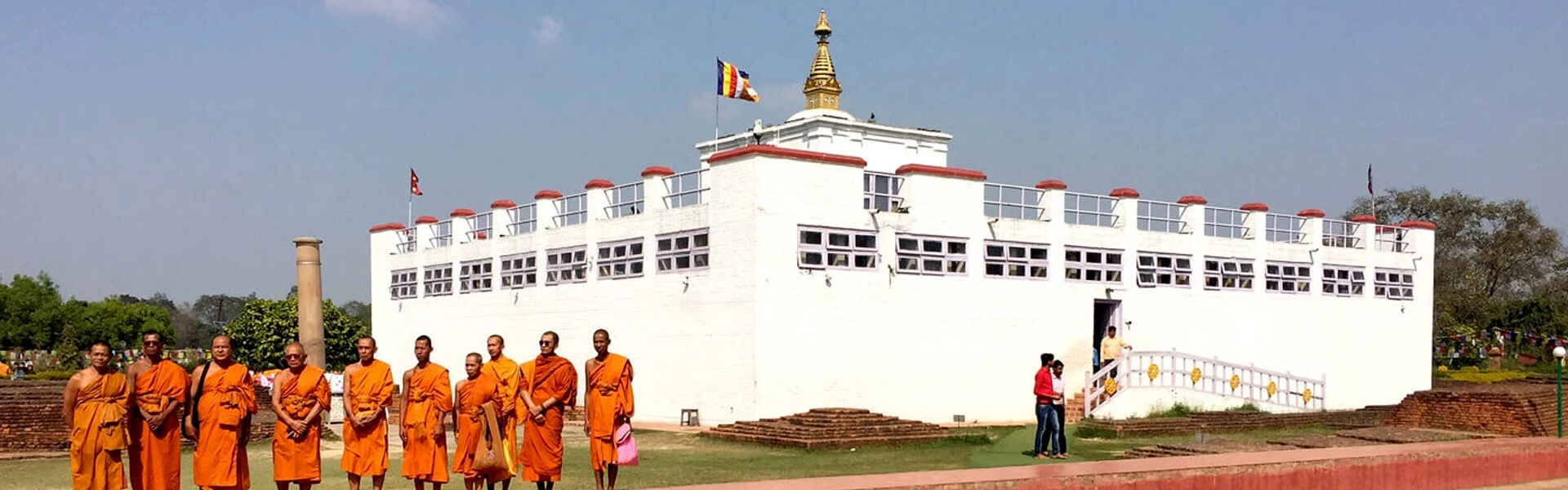
- Maya Devi Temple Lumbini: No list of things to do in Lumbini is complete without mentioning the visit to Maya Devi Temple, one of the major Lumbini temples, the heart of the region dedicated to the mother of Lord Buddha, characterised by marker stones, ancient ruins, and the abundant spiritual ambience.
- Lumbini Ashoka Pillar: Built by Magadha Emperor Ashoka in 249 BCE, exactly outside of the Maya Devi Temple, is the historic Lumbini Ashoka Pillar, which identifies the exact birthplace of the Buddha in addition to its connection to ancient political history with the rise of Buddhism and the contribution of Emperor Ashoka.
- Sacred Garden: Surrounding the sacred pond of Puskarini, along with the above-mentioned two of the significant landmarks in Lumbini, is the sacred garden that further features landscape paths, ancient remains, prayer flags, and a beautiful garden perfect for quiet reflections and peaceful strolling.
- World Peace Pagoda: In the international monastic zone, which is characterised by group monasteries, such as the Royal Thai Monastery, the Chinese Monastery, and the German Monastery, there is a World Peace Pagoda (Nipponjan Myohoji) that is renowned for its gilded statues of the Buddha marking the cardinal directions.
- Lumbini Museum: Another major highlight of Lumbini in Nepal is the nearby museum, which was established to truly understand Buddhist history, archaeological discoveries, and the universal significance of Lumbini through artefacts, photographs, and manuscripts explaining the importance of Buddhist heritage in the world.
- Lumbini Crane Sanctuary: For those intrigued by nature, you will be fascinated to know that Lumbini further hosts wetlands and landscapes that serve as a perfect natural habitat for a wide range of birds and wildlife, including the endangered Sarus crane. I.e., Lumbini does strike a balance of cultural sightseeing with nature observation.
Weather and temperature in Lumbini
While the exact weather and temperature vary from season to season, like in any other trekking and climbing region and tourist destination of Nepal, as Lumbini lies in the lowlands of Terai, unlike the temperate climate of Kathmandu or Pokhara, the temperature in Lumbini is subtropical, characterised by hot summers, mild winters, and humid monsoons, where the spring and autumn are noted for the most pleasing ambience for touristic activities.
That means visiting Lumbini is doable throughout the year, especially when the place is one of the must-visit destinations in Nepal with easy accessibility and well supported by modern infrastructure offering budget-friendly to luxury services. For the best weather in Lumbini with the most comfortable temperature in Lumbini, it is good to plan the Himalayan holidays to Lumbini in spring (March-May) and autumn (September-November).
How are Lumbini Hotels?
Since Lumbini does not fall into the remote and rugged Himalayan regions of Nepal like several other popular treks and climbs that the country is known for, you won’t have to worry about having to adjust to basic teahouses often offering staple Nepalese and Tibetan dishes. It offers a wide range of accommodation and menus to choose from, the one that suits you the best as per your budget and requirements, such as fully vegetarian or lactose-free or more.
From budget guest houses (Lumbini Village Lodge), pilgrimage-dedicated accommodation (Korean Monastery stay), mid-range hotels (Hotel Buddha Maya and Hotel Peaceland), and 5-star resorts in Lumbini such as Tiger Palace Resort in Bhairahawa with better facilities, including swimming pools, spas, fine dining restaurants, and casinos, let us know how you plan to explore the birthplace of Buddha so we can make essential arrangements likewise.
How Many Days Are Enough for Lumbini?
Although at last the best Lumbini visiting itinerary is for you to choose as per your area of interest, time constraint, and budget, at Adventure Himalayalan Travels and Treks, we are happy to offer you customisation services where our local, highly knowledgeable, experienced, trained, and licensed experts ensure you a personalised journey specifically made for you. Or simply book the Buddhist Darshan Tour of 10 days.
Otherwise, from one day of the Lumbini Tour focusing on the Maya Devi Temple, Ashoka Pillar, Sacred Garden, Puskarini Pond, and World Peace Pagoda to 2 days of the Lumbini Trip for a more relaxed experience, and even a 3-day itinerary for a more holistic journey dipped in spirituality and local culture, and making the best out of the nearby historical destinations, we are here for you 24/7, located at the heart of the Kathmandu Valley, Thamel.
Essential Travel Tips for Visiting Lumbini
Whether you are heading to the remote Himalayas of Nepal or pilgrimage sites like Lumbini, a little preparation can greatly enhance the trip, so we suggest that you dress modestly, begin sightseeing early in the morning, carry water and sun protection, check the transport schedules and opening hours of the site, and have enough time for a thorough exploration without a rush, especially if you are travelling with your family, including seniors and children.
Similarly, though the local culture, customs, and traditions may be completely different from what you have been used to seeing and brought up to, it is a must that you show respect. So it is always better to book the trip early through a government-registered trekking agency, operator, or organiser like Adventure Himalayan Travels and Treks. We excel in epic Nepal, India, Tibet, Bhutan, and Tibet treks, tours, and expeditions.
Conclusion
The UNESCO-listed heritage from Nepal, Lumbini, is more than a destination; it is a living pilgrimage to take pause, reflect, and be one with universal spiritual traditions that strongly emphasise world peace, non-violence, harmony, and ultimate liberation. The birthplace of the founder of Buddhism himself, Gautama Buddha, hear the calling of Lumbini yet? Answer it now and reserve your seat for 2027 and 2028.
This guide discussing the Lumbini location, weather in Lumbini, distance from Kathmandu or Pokhara, and major highlights such as Maya Devi Temple, Lumbini, Ashoka Pillar, and the World Peace Pagoda is to help you make up your mind for what awaits you, make the best out of the trip guided by eco-friendly and responsible tourism, focus on leaving each site you visit better than before, be part of a meaningful journey, and save your spot now.