Mount Kailash stands out as one of the world’s most sacred and mysterious peaks, revered as a primordial spiritual center or origin point by Bon, Buddhism, Hinduism, and Jainism. Located in Tibet, it is far beyond a remote and rugged Himalayan mountain in a high-altitude desert. No wonder every year the popularity of the Kailash Tour pilgrimage that we at Adventure Himalayan Travel and Trek provide is growing day by day.
Thousands of pilgrims set out for the Kailash Kora, often combined with a side trip to Alpine Mansarovar Lake, and are altogether referred to as the Kailash Mansarovar Yatra. If you are also planning it for 2026 and 2027, here are some of the must-knows about Mount Kailash Tibet for a seamless experience from start to end. Mount Kailash Mystery, How high is Mount Kailash?, permits, and first-time Mount Kailash pilgrimage tips to pay attention to.
Table of Contents
Where Is Mount Kailash Located?
Considered the axis of the universe, a point where heaven and earth meet, Mount Kailash, Kailash Parbat in Hindi, near the source of four major rivers of Asia: the Indus, Sutlej, Brahmaputra, and Karnali, sits in the Nagari Prefecture of the western Tibet autonomous region. With the snow cap that never melts, it rises above high-altitude plateaus, pristine lakes, and unique yet beautiful landscapes; the journey here is as scenic as it is spiritual and religious.
Close to Lake Mansarovar, which in Hindu tradition is believed to be created by the thoughts of lord Brahma, Rakshas Tal (the demon lake), with a connection to Hindu legend being one created by the demon king Ravana for mediation, Dolma La Pass, Dirapuk Monstery, and Gauri Kund, people from various faith sees it as the cosmic center, linking the physical and metaphysical realms. A symbol of the perfect blend between the material world and divinity.
What is the Mount Kailash height?
When answering the question, how high is Kailash Mountain? While it is not among the tallest mountains in the Himalayas, like those in Nepal: Mt. Everest (8,848.86 m/the top of the world), Kanchenjunga (8,586 m/the 3rd tallest mountain in the world), and so on, its spiritual significance far exceeds its physical height. You still journey several days in the alpine zone where the level of oxygen drops significantly, so it should not be taken lightly.
I.e., when prepared for the travel, trek, and tour to the lone giant in the area, isolated from surrounding peaks in Tibet, you get an exceptionally breathtaking sight to behold. Situated at an altitude of 6,638 m/21,778 ft above sea level, with its four faces closely aligning with cardinal directions—North, South, East, and West— it has sparked countless myths and spiritual interpretations throughout history. Are you ready to unveil its mystery?
What does the Kailash look like?
One of the most notable features of Mount Kailash in Tibet is its unique pyramid-like shape, which scientists believe to be a made vacuum pyramid surrounded by 100 smaller pyramids. Measuring 100 - 1,800 m tall, surpassing even those in Egypt, it is a gem for curious minds eager to discover the real truth, an incredible fascination for scientists and geographers alike. What’s even more interesting is that it is 6,666 km from Stonehenge in the UK.
Likewise, the distance to the South Pole is 13,332 kilometers and is twice the distance to Stonehenge from the North Pole. From the vast Tibetan plateau, it would be epic to witness the dark rock faces capped with white snow, creating a giant crystal or sacred temple-like structure, an otherworldly heavenly sight. In stark contrast to barren hills and high-altitude valleys, the peak looks even more stunning at sunrise, as sunlight takes on various shades of gold.
Why is Mount Kailash so sacred?
Unlike other famous and high peaks around the world, Mount Kailash, or Kailash Prabhat, remains unclimbed. There are records of summit attempts in 1926, 1936, the 1980s, and 2021, but not of ever reaching the top. With the folklore of Tibetan yogi and poet Milarepa being the only person who made it to the Kailash Parbat summit point, it is now completely banned due to preserving its sanctity and mystery, deeply sacred to Bon, Jain, Buddhism, and Hinduism.
Hindus believe it to be the abode of one of the major Hindu lords, Shiva (the Hindu god of destruction), and his spouse, goddess Parvati. In Buddhism, it is revered as the dwelling place of Demchok (Chakrasamvara), a deity who represents supreme bliss. Likewise, Jains cherish Kailash as the site where the first Tirthankara obtained liberation, and last but not least, in the Bon religion, it is considered the spiritual center of the universe.
Understanding Kailash Darshan
Devotees across the world believe that even a glimpse of Mount Kailash can help one end the karmic cycle and earn merits of a lifetime on the Kailash Yatra for Kailash Darshan, which basically means receiving the sight of Kailash Parvat. It is why, despite its challenging high-altitude terrain and harsh weather, a great number set out on a journey to take at least one round trip of the peak, which is called Kora, and be free from sins of a lifetime.
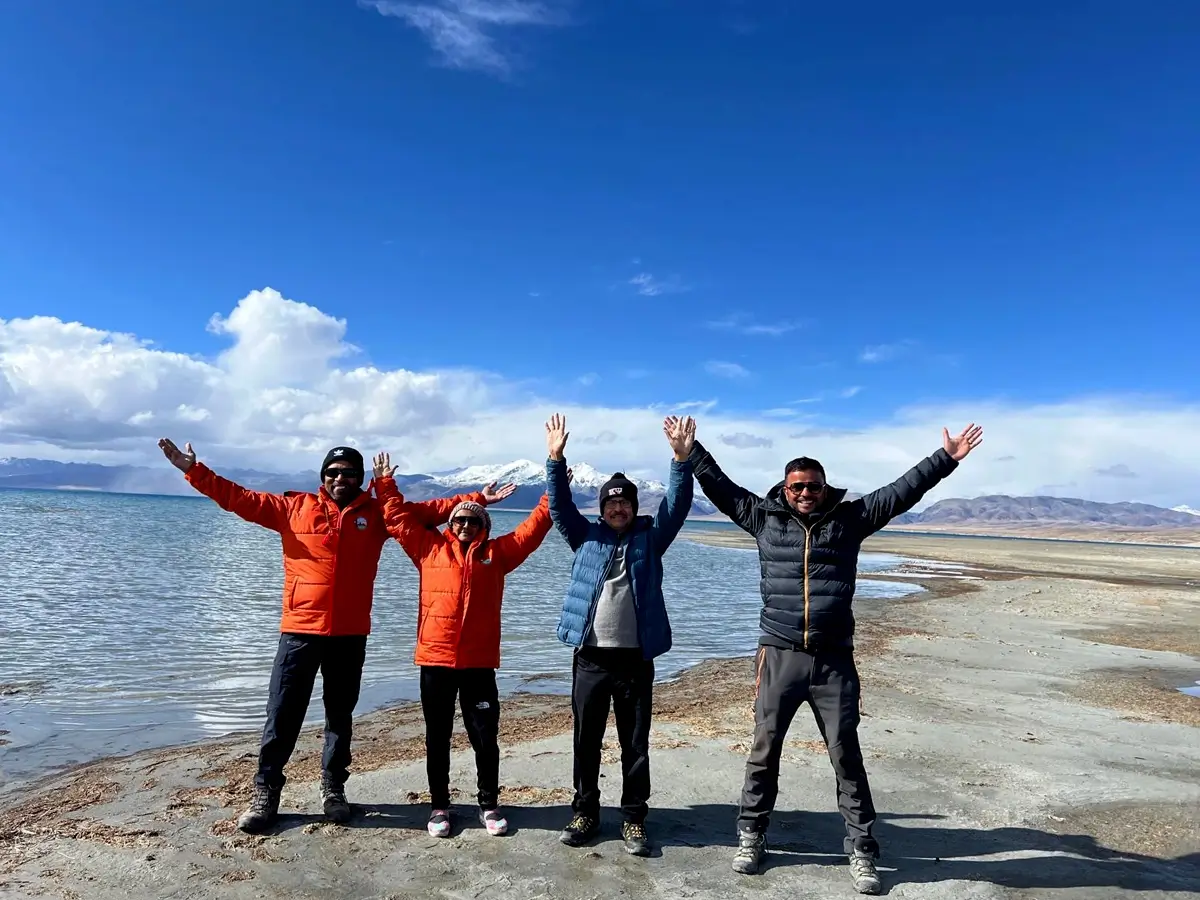
Usually, the Mount Kailash Kora begins with a drive to Yama Dwar (Tarboche Valley) from Darchen, one of the traditional villages, after you visit an inspirational time at Lake Mansarovar (4,590 m), around 30 km from Mount Kailash. Take a holy dip here, reach Darchen, and let yourself be free for a reflective Himalayan trip. Get ready to be mesmerized by nature’s grandeur and how spirituality works, covering around 52 kilometers, usually in 2 - 3 days.
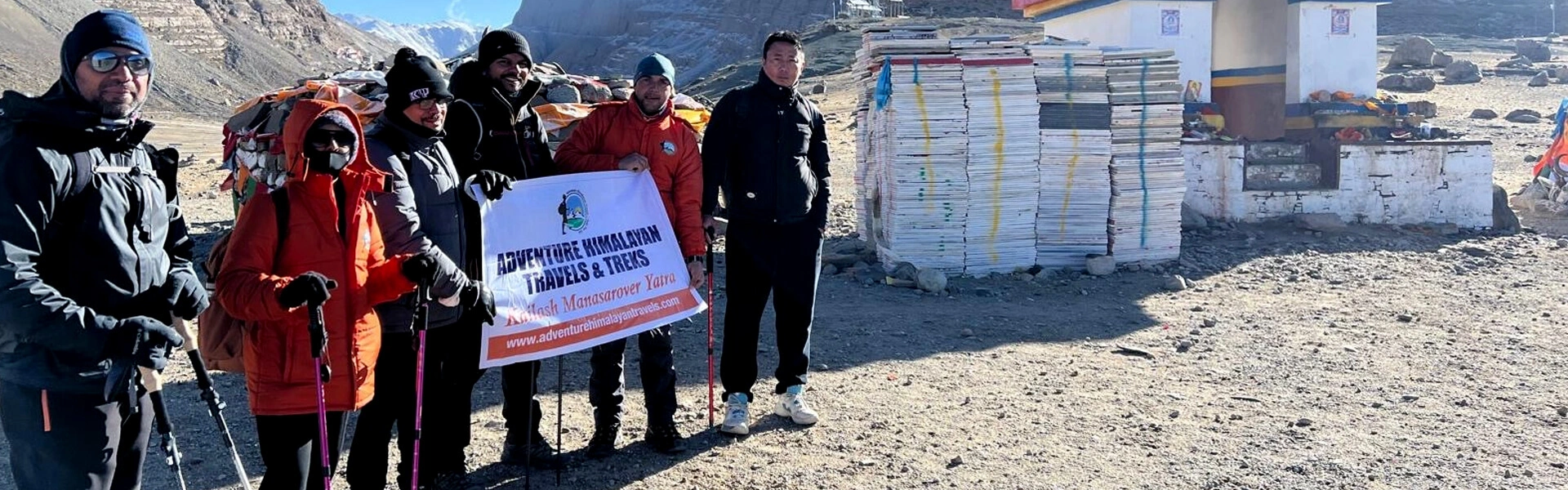
A team from the Adventure Himalayan Travels and Treks on the Kailash Yatra
What does Kailash Kora involve?
While the chosen route, weather, transport, acclimatization, and individual fitness do noticeably help in deciding the Mount Kailash Tour itinerary duration, including the Kailash Kora, as mentioned above, it generally spans 3 days beginning from Yama Dwar after a drive from Darchen. On the 1st day, you reach Diraphuk and spend the night here, and on the next day, you head to Zuthulphuk, which involves crossing the Dolma La Pass (5,645 m).
On the third day, there is a descent to Dongba and also marks the completion of the Kora. The first day walk is relatively gentler; the second day, including crossing one of the high mountain passes in Tibet, is challenging, and the third day involves descending trail hiking and should not be an issue to anyone with a good level of physical fitness, including first-timers. Walk an entire route, or if lucky, you may even use pack animals or locals to support the portions of it.
How to reach Kailash? Route Options
Despite sharing borders with India, Myanmar (Burma), Bhutan, and Nepal, Tibet, it is accessible only via mainland China and Nepal. From Nepal, you have options like the overland route via the Kathmandu-Kerung border, the helicopter route via Simikot or Hilsa, and one of the most popular choices, the overland route via Lhasa. During the Kailash Mansarovar Yatra and Muktinath Tour, it is from Kerung border, you enter Tibet to visit Kailash Parvat.
From Kerung, you slowly ascend through Saga and Paryang to Lake Mansarovar and eventually to Kailash Parvat. Likewise, the Kailash Mansarovar Helicopter Tour is the faster option. You board a flight to Nepalgunj, then to Simikot and Hilsa at the Nepal-China border, to continue driving to Purang and the sacred Lake Mansarovar. This means the Lhasa-Everest Base Camp to Mount Kailash tour first flies to Lhasa, explores the area, and heads towards Kailash.
Permit for the Kailash Tour in Tibet
Whether you are traveling to Tibet to explore its capital city, Lhasa, and other popular cities, or the North Everest Base Camp, also called Rombuk Monastery, or combined Lhasa and Everest Tour, Tibet Nepal Bhutan Tour, or completing the Kailash Yatra with Kailash Kora, it is a must that the trip be guided. It is mandatory that you follow the international border regulations and obtain all the required permits set by the Chinese authorities. The first one is the Chinese Group Visa.
Then you will need a Tibet Travel Permit (TTP), an Alien Travel Permit, and Kailash region permits, with the compulsion to be a part of an organized group with an authorized travel operator that we, Adventure Himalayan Travels and Treks, are. Further, Indian nationals may be required to submit an indemnity bond and consent forms in regard to emergency evacuation and other risks. All of these are a must for a legitimate Kailash Yatra experience in Tibet.
When is the best time for visiting Kailash?
At your request, our more than two decades of experience in organizing memorable Himalayan holidays in Nepal, Bhutan, Tibet, India, and Singapore gives us an edge to be able to organize the trip to Tibet for Kailash Yatra and complete the Kailash Kora throughout the years. There is hardly any debate about the months of spring and autumn. The months from March to May and September to November feature the most stable weather.
In pre-monsoon and post-monsoon times of the year, the chances of both rain precipitation and snow are lower, resulting in the safest trails for traveling. Clear skies, moderate temperatures, and mostly dry trails with excellent visibility further our fixed departures, including for the years 2026 and 2027. Book now, especially when May to June also coincides with the famous Saga Dawa Festival (a celebration of Lord Buddha’s birth).
Preparation tips for Kailash Travels and Treks
If it is your first time onto the Tibetan high plateau or even a second time or more, here are some practical tips to follow for better safety and comfort during the trip to Mount Kailash. Although it may not be a high-altitude trek in Nepal like the Everest Base Camp Trek, the Annapurna Base Camp Trek, the Manaslu Circuit Trek, and the Annapurna Circuit Trek, it is still a journey of 3,000 m above sea level for several days.
So, you must respect high altitude, and before going into higher regions, ensure proper acclimatization. In the same way, the weather in Tibet fluctuates widely, so make sure you have enough and the right gear. Thermal base layers, fleece mid layers, and wind- and water-proof jackets, including sturdy trekking boots, are basic. Ensure that you have enough RMB to exchange in Kathmandu before you leave for the Tibet Kailash tour.
Conclusion
The Mount Kailash Tour, or Mount Kailash Tibet Yatra, is one of the most meaningful pilgrimages you can undertake, including for the years 2026 and 2027. When you know the Kailash Mountain height, demands of the Kora, and Kailash weather, it becomes clear that the journey does test your body, but the profound opportunities for rejuvenation make all the effort worthwhile. Get ready to embrace the Mount Kailash Mystery.
The place that unites multiple faiths across the globe, we at Adventure Himalayan Travels and Treks are taking bookings for 2026 and 2027 to complete the Kailash Darshan. Choose one of our comprehensive Mount Kailash Tibet tour packages or customize as per your specific area of interest and preferences. Trusted by many, able to receive 4.8/5 ratings on Tripadvisor, with us, you are in the hands of local experts who find pleasure in making your dream come true!
Rana Bahadur Khadka
In the world of outdoor adventure and exploration, only passionate individuals immersed in the wilderness can be travel guides in Nepal! My name is Rana Bahadur Khadka, and I am from Taplejing, Nepal. Born in 1971, I have collected 30 years of extensive knowledge in travel and tourism as a mountain guide and trip organizer. I have always been fond of exploring and navigating various gorgeous corners of the world and the challenges offered by nature.
I hope that my over two decades of honed skills in mastering the art of leading treks safely, ensuring the participant's memorable and transformative travel experience, and my vivid insight into the world of adventure, nature, and self-discovery help you bridge the gap between the pristine Himalayan grace and the human spirit as an ambassador of the wilderness.
Drop us a message
Latest Travel Guides
Our travel guides giving you travel insights, ideas, and tips across the Himalaya.